
Richard Kirtley, Jul 10, 2026
There are certain words that become so universally admired that, over time, they stop describing anything particularly well. They become badges of virtue rather than definitions. We hear them repeated so often, in so many different contexts, that we stop asking what they actually mean. Community, I would argue, is one such word. It appears in strategies, funding programmes, investment funds, regeneration initiatives, political speeches and corporate mission statements with such regularity that it has acquired an almost magical quality. Attach community to almost any project and it immediately sounds warmer, kinder and somehow more legitimate. The word reassures us before we’ve even looked beneath the surface. Lately, though, I’ve begun to wonder whether, in our eagerness to demonstrate social purpose, we’ve allowed community to become so broad that it no longer distinguishes one purpose or form of investment from another. Perhaps, in doing so, we’ve quietly started treating things that are community-led and things that merely benefit communities as though they were one and the same.
The thought first occurred to me when I was reflecting on the Community Enable Fund (CEF). For those unfamiliar with it, the CEF is an investment fund that provides loans of £25,000 and above to SMEs that have often struggled to secure finance through mainstream lenders. The fund aims to unlock growth, create jobs and generate both financial and social returns through enterprise. Before I go any further, I really want to be clear that I’m a strong supporter of the CEF. This isn’t a criticism of the fund itself; indeed, it’s quite the opposite. I think Britain desperately needs more organisations willing to provide patient, intelligent capital to businesses that fall outside the increasingly narrow lending criteria of mainstream banks. There are thousands of SMEs with viable businesses, sound ideas and enormous potential who are turned away because they don’t quite satisfy a lending algorithm, because they’ve experienced financial difficulties or cashflow pressures, or because the circumstances of the business simply don’t fit neatly into a credit policy written hundreds of miles away. If we want productive local economies, thriving businesses and meaningful job creation, then funds willing to back overlooked enterprises are not simply desirable. They’re completely and utterly essential.
The more I found myself reading about the fund, the more another question began to emerge. If we stripped away the title and simply described what it does, would we naturally call it a community fund at all? In reality, it is an SME lending fund. It provides substantial loans to businesses. Those loans are expected to generate a financial return for the investor while enabling businesses to grow, employ people and contribute to the wider economy. There is absolutely nothing wrong with that. In fact, it’s precisely the kind of investment our economy needs more of. Yet I couldn’t help wondering why we instinctively reach for the language of community rather than simply celebrating it for what it is: business finance with a social purpose.
The obvious response, of course, is that businesses benefit communities. Every successful business creates value beyond its own balance sheet. It employs local people, purchases from nearby suppliers, occupies high streets that might otherwise stand empty, pays taxes that fund public services and often contributes generously to local charities, schools or sports clubs. Healthy businesses help create healthy places. Anyone who has spent time working in economic development knows that to be true. In many towns, small businesses are the glue that holds local economies together. They provide first jobs, keep money circulating locally and create opportunities that simply wouldn’t exist without them.
This is where I found myself reconsidering my own argument.
Perhaps the issue isn’t that these funds use the word community. After all, Community Development Finance Institutions (CDFIs) have existed for decades, and there is a perfectly coherent philosophy behind that title. They do not claim to lend to communities; they claim to use finance as a tool for community development, and that is an important distinction. Their purpose is to correct market failure by directing capital towards people and places that mainstream finance has overlooked. In that sense, community describes the institution’s mission rather than the legal status of its borrower.
I think that’s a persuasive argument, but it also leads me to another question.
Where does community development end?
If any investment that creates employment or stimulates economic activity is automatically community development, then the definition begins to expand almost without limit. A loan from NatWest to a growing engineering firm creates jobs. A Lloyds facility for a manufacturer strengthens the local economy. HSBC financing a retailer might keep dozens of people in work. Those investments undoubtedly benefit communities. Yet we wouldn’t ordinarily describe those banks as community development institutions. Something else is clearly at work.
Perhaps, then, the distinction lies not in what is being financed, but in why.
A genuine CDFI exists because conventional markets have failed. It deliberately accepts a level of risk that commercial lenders will not. It lends into places others avoid. It backs businesses and entrepreneurs whom traditional finance has deemed too complex, too small or too unconventional. Community, in that context, isn’t a marketing slogan. It’s a statement of intent. The institution exists because certain communities have been excluded from access to capital.
That feels entirely legitimate.
But I do wonder whether, over time, we’ve quietly broadened that definition beyond its original purpose. Somewhere along the way, we seem to have started describing almost any socially beneficial investment – even where the community benefit is relatively small or indirect – as community investment. SME lending becomes community lending. Commercial finance becomes community finance. Economic development becomes community wealth-building. The language expands a little further each year until almost everything that has a positive social consequence can comfortably sit beneath the same banner.
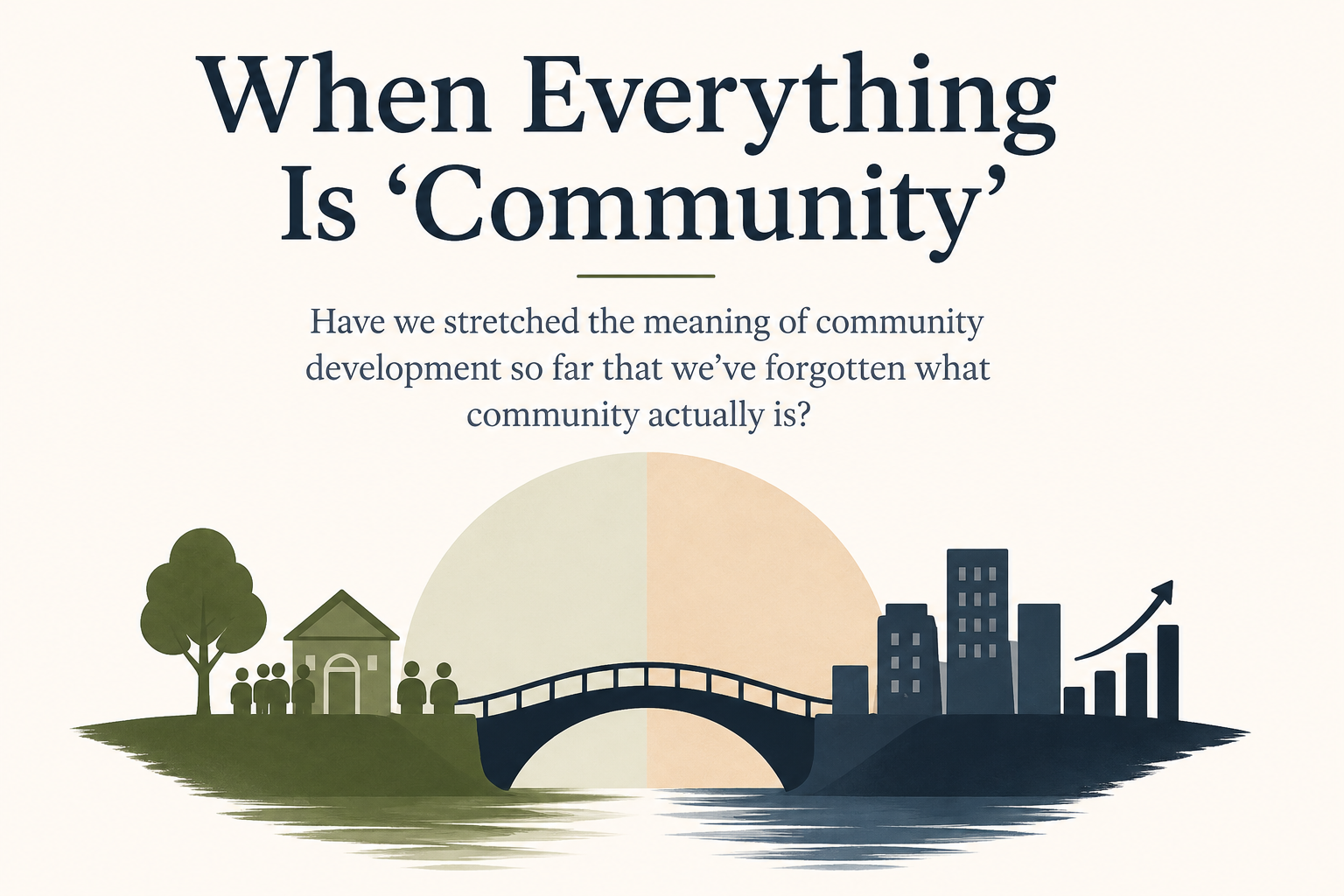
I think this is where my discomfort really lies. I think we’ve begun to confuse things that are community-led with things that simply benefit communities.
These are not the same thing.
When residents come together to reopen a village shop, restore a neglected park or transform an abandoned building into a youth centre, the community is both the architect and the beneficiary of the work. When unemployed people are supported into employment or self-employment because nobody else is willing to give them a chance, the intervention begins with the needs of the community itself. When local people identify a problem, design the solution and shape the outcome, that feels instinctively like community development in its purest form.
By contrast, when an established SME receives a growth loan, the community may well benefit enormously. New jobs may be created. Apprenticeships may follow. Local suppliers may flourish. The high street may become busier and more prosperous. Those are wonderful outcomes, and they deserve celebrating. But they are still downstream consequences of supporting a business. Importantly, the investment begins with the enterprise, not with the community itself.
I would argue that this distinction matters, not because one approach is morally superior to the other, but because they are fundamentally different forms of intervention.
I will also say that my own perspective has been shaped by the work we do at Purple Shoots. Every week we lend to entrepreneurs who have been rejected elsewhere. Many have poor credit histories. Many rely on benefits. Many have been told, explicitly or implicitly, that they simply aren’t investable. We support them because we believe enterprise changes lives. Sometimes those businesses remain one-person operations that simply provide security for a family who had previously been living week to week. Sometimes they become employers. Sometimes they grow into businesses that transform their local economies. The community impact is undeniable. But we’ve never felt the need to disguise what we’re doing. We lend to entrepreneurs. We believe that helping excluded people build successful businesses is socially valuable in its own right. The community benefits because those individuals succeed.
There’s something refreshingly honest about that.
This may all sound like semantics, and perhaps it is. But language shapes the way we think, and the way we think shapes the policies we design. If every investment with even the slightest positive social outcome becomes community investment, then eventually the word community ceases to distinguish anything at all. It becomes a reassuring label rather than a meaningful description. When that happens, we risk overlooking the very different needs of genuinely community-led initiatives that deserve investment on their own terms.
None of this is an argument against business finance. In fact, it is precisely the opposite. I wish we were more confident in defending it. There is no shame in believing that businesses deserve investment. There is no shame in recognising that entrepreneurs create opportunity, that successful firms strengthen places and that economic development is itself a public good. We shouldn’t feel obliged to wrap those beliefs in softer language to make them acceptable.
Ultimately, this is my real point. Business finance with social purpose is something to be proud of. Community-led development is something to be proud of too. They often overlap. They frequently reinforce one another. But they are not the same thing, and I wonder whether our language would become clearer, and our thinking sharper, if we were just a little more willing to acknowledge the difference.