
Richard Kirtley, Jun 12, 2026
There is an often held assumption running through almost many conversations we have about economic growth in Britain. It appears in government policy, local authority strategies, skills programmes, economic development plans and business support initiatives. Whether stated explicitly or not, the underlying belief is remarkably consistent: if we can attract enough employers, help existing businesses grow, and connect enough people to jobs, prosperity will follow. Employment is viewed as the primary mechanism through which people participate economically, earn an income, build security and contribute to society. It is so deeply embedded in our thinking that we rarely stop to question it.
For much of the twentieth century, there was good reason for this. The economic landscape was dominated by large employers. Across Britain, entire communities were built around steelworks, factories, mines, ports and industrial plants. In Sheffield, tens of thousands of people worked in steel and engineering. In Newcastle, shipbuilding shaped entire neighbourhoods. In South Wales, coal mining provided livelihoods across generations. Employment was not simply a source of income; it was often a source of identity, community and belonging. Economic growth was largely understood through the lens of industrial expansion and job creation, and for many decades that model delivered remarkable results.
But, I believe there is a danger in assuming that what worked in one era will necessarily work in another. The further we move into the twenty-first century, the more it appears that we may be trying to solve tomorrow’s challenges using yesterday’s assumptions. The world that created the great industrial employers is disappearing, and with it disappears the notion that economic participation will primarily be delivered through ever-larger organisations employing ever-greater numbers of people.
To understand why, I think it is worth looking backwards rather than forwards.
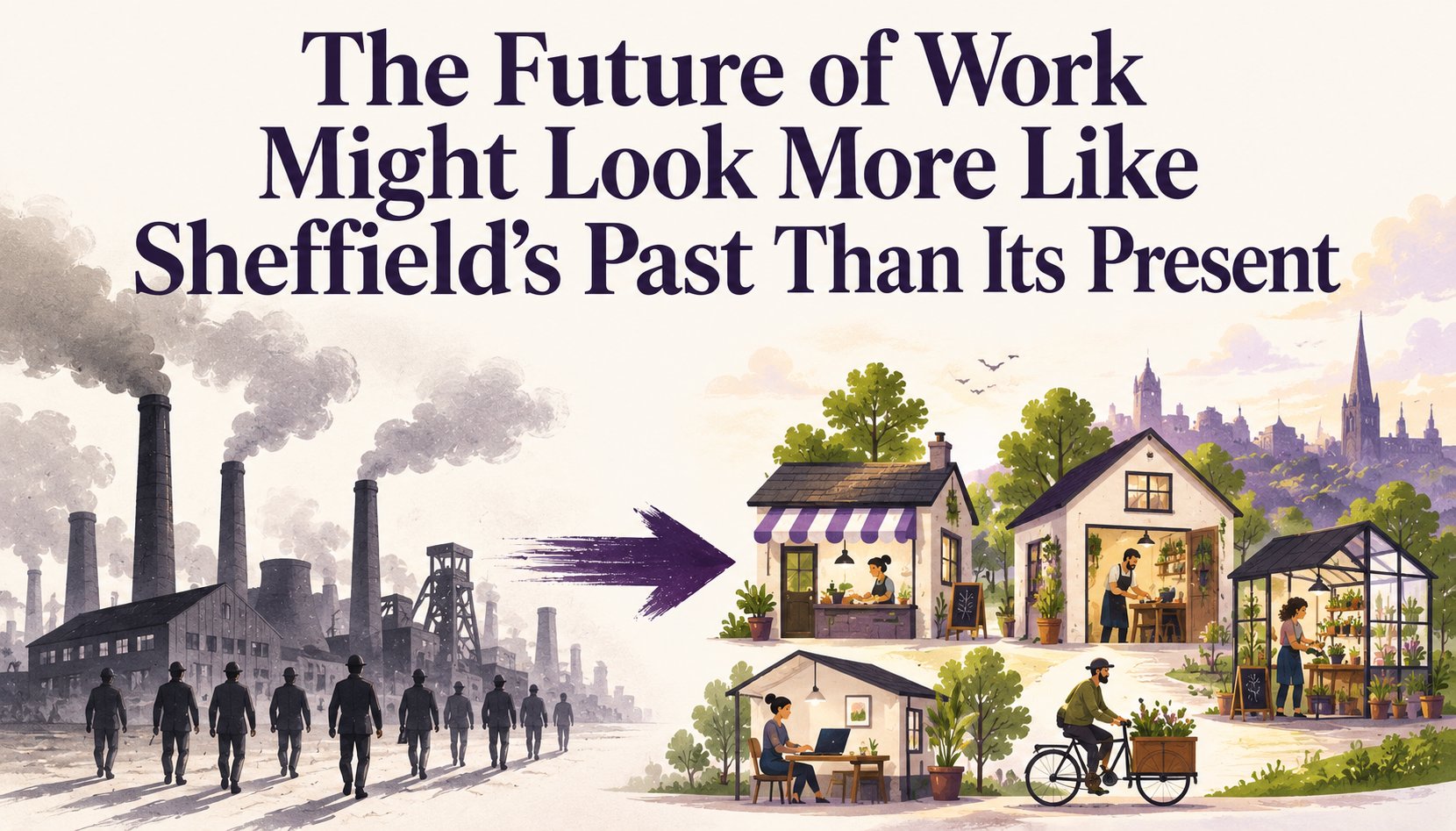
Before Sheffield became synonymous with steel, before the giant works and foundries dominated the skyline, before names such as Vickers, Firth Brown and Forgemasters became known around the world, the city’s economy looked very different. Economic activity was distributed across thousands of individuals and small enterprises. Knife grinders worked from small workshops. Smiths operated modest forges. Craftspeople specialised in tiny parts of increasingly complex production processes. Entire families often participated in economic activity from their homes or small rented premises. The city was not powered by a handful of giant employers. It was powered by countless small producers connected together through trade, relationships and shared expertise. I often run up the Porter Valley in Sheffield and encounter this history. Small dams constructed to create reservoirs with enough power to turn small wheels, in turn powering grinders and forges. Homes bolted onto the side of these micro-factories so the whole family could be involved.
What is often forgotten is that the industrial giants themselves emerged from this ecosystem. They did not descend from the heavens as multinational corporations. They began as small enterprises. Sheffield Forgemasters traces its roots back to a modest eighteenth-century foundry. The firms that would eventually employ thousands of people were, at one point, little more than local workshops serving local markets. The vast industrial economy that defined Sheffield for much of the twentieth century emerged from a foundation of entrepreneurship, craftsmanship and small-scale enterprise.
This is important because it reminds us that large employers are not the natural starting point of economic development. They are often the end result of it.
For a period of history, those businesses grew to extraordinary scale. Vickers and its associated companies employed tens of thousands of people. The great steel firms became economic institutions in their own right. Their success shaped not only Sheffield’s economy but also its politics, culture and physical landscape. But if we look at those same businesses today, something new has happened. They continue to generate enormous value, they remain technologically sophisticated and they still produce world-class products. However, they do so with a fraction of the workforce that would once have been required.
Importantly, this is not a story of failure but, quite the opposite, it is a story of productivity.
The uncomfortable reality, however, is that productivity and employment are no longer travelling hand in hand in the way they once did. Technology has enabled organisations to produce more with fewer people. Automation has replaced tasks that once required human labour. Digital systems have reduced the need for administrative staff. Global supply chains have transformed production. A modern manufacturing plant may produce more output than its twentieth-century equivalent while employing only a fraction of the workforce. From the perspective of shareholders and economists, this is often presented as progress. From the perspective of communities seeking meaningful economic participation for their citizens, it raises more complicated questions. Now artificial intelligence is arriving.
There is a growing tendency to either dismiss AI entirely or to catastrophise about it. Both positions miss the point. The question is not whether AI will replace every job. It almost certainly will not. The question is whether it will continue the long-running trend of allowing organisations to create increasing amounts of value with fewer people. If it does, then many of our assumptions about employment, growth and economic participation will need to change.
Historically, whenever new technologies emerged, they displaced some forms of work but created others. The mechanisation of agriculture reduced the need for farm labourers but created opportunities in manufacturing. Industrialisation reduced demand for artisans but generated employment in factories. The digital revolution eliminated some clerical roles whilst creating entirely new industries. There is every chance that artificial intelligence will follow a similar pattern. New opportunities will emerge. New sectors will be created. New forms of work will develop that are currently difficult to imagine.
The difference is that this time we are dealing with a technology that is capable of replicating not only physical labour but increasingly cognitive labour as well. Tasks that once required years of training can now be completed in seconds. Research, administration, design, coding, marketing and analysis are all becoming dramatically more productive. This is wonderful news if your objective is efficiency. It is less clear what it means if your objective is widespread economic participation.
For more than a century we have assumed that productivity gains would eventually translate into more jobs, more consumption and more prosperity. However I would argue that it is becoming increasingly plausible that we are entering an era where productivity can continue to rise whilst employment opportunities become more concentrated. A small number of highly productive businesses may be capable of generating extraordinary value with relatively few people. If that proves true, then our economic challenge changes fundamentally. The question is no longer simply how we create growth. The question becomes how we ensure people are able to participate in that growth.
This is where I would argue that the conversation about micro-enterprise becomes far more important than many policymakers currently recognise. Too often, self-employment and small business creation are viewed as niche activities. They are presented as alternatives for people who cannot access traditional employment or as stepping stones towards creating larger businesses. But, what if they are something much more significant? What if they represent one of the most important mechanisms through which people will participate in the economy of the future?
The statistics already point in this direction. Almost every business in Britain is an SME. The overwhelming majority are micro-businesses employing fewer than ten people. Millions of people already derive their income through self-employment, freelancing, sole trading or small business ownership. While politicians frequently focus on attracting major employers, the reality is that much of the economy already rests upon the shoulders of countless small enterprises operating beneath the national radar.
What these businesses lack is not importance. What they lack is recognition. They are rarely invited into conversations about national economic strategy. They rarely feature in grand announcements about growth. Their owners are regularly overlooked by mainstream finance and yet, collectively, they represent one of the largest reservoirs of productive capacity in the country.
This becomes even more significant when we consider the people currently excluded from economic participation altogether. Across Britain there are millions of people with skills, ideas, experience and ambition who struggle to access traditional employment. Some are managing long-term health conditions. Some are carers. Some have experienced redundancy. Some have been written off by financial systems that struggle to accommodate lives that do not follow a neat and predictable pattern. The prevailing assumption is often that these individuals need to be reconnected to employment, but from what I have seen, this is the wrong starting point. Perhaps the question should be how we enable them to create economic value in ways that fit around their lives.
This is one of the lessons we repeatedly encounter through the work of Purple Shoots. The entrepreneurs we support are often described through the lens of exclusion. They are people excluded from mainstream finance. Excluded from traditional opportunities. Excluded from systems that were not designed with them in mind. Yet there is another way of looking at them. They may not be examples of people left behind by the future economy. They may be early examples of what the future economy increasingly looks like.
Flexible, local, distributed, agile, adaptable and rooted in relationships rather than institutions. Enabled by technology but deeply connected to place. The more I think about this, the more strange our current policy priorities begin to appear. We spend enormous sums attempting to attract large employers into towns and cities, often celebrating the creation of a few hundred jobs. Yet relatively little attention is given to helping thousands of local residents create sustainable livelihoods of their own. We invest heavily in infrastructure, skills and business support programmes, but comparatively little in the patient finance and relational support that enables someone with an idea to take their first step.
Imagine if every neighbourhood had access to community finance. Imagine if every aspiring entrepreneur could access modest amounts of patient capital alongside mentoring and support. Imagine if procurement systems actively favoured local suppliers (I know the Procurement Act 2023 was meant to address this, but from the ground I have seen it to make little material difference). Imagine if economic development strategies focused as much on creating business owners as they do on creating employees. The cumulative effect of such an approach could be transformative.
This is not because every micro-business will become the next Forgemasters. Realisitically the vast majority will not and this is not the point.
My point, instead, is that resilience emerges through diversity. We see that an economy dependent upon a handful of major employers is inherently fragile. When one employer closes, thousands suffer. When opportunity is distributed across thousands of enterprises and sole traders, shocks are absorbed more easily. Wealth circulates more locally. Communities become less dependent on decisions made in distant boardrooms. Economic participation becomes something that people actively shape rather than passively receive.
In many ways, this represents a return to something that previous generations would have recognised instinctively. For most of human history, economic participation was not primarily about securing employment. It was about creating value. People made things, sold things, fixed things, grew things and traded things. Employment, as we understand it today, is actually a relatively recent phenomenon when viewed across the sweep of history.
Thinking a bit deeper about it, perhaps the twentieth century was the anomaly. Perhaps the era of giant employers providing lifelong careers for vast workforces was a unique moment created by a particular combination of industrial technologies, demographics and economic structures. Perhaps we are now returning, albeit in a technologically transformed form, to a more distributed model of economic life.
If that proves to be true, then the implications are profound. The future of economic development may depend less on attracting the next multinational employer and more on unlocking the productive potential that already exists within our communities. It may depend less on finding jobs for people and more on enabling people to create value for themselves and others. It may depend less on concentration and more on participation.
The irony is that the future we are moving towards may not be entirely unfamiliar. Sheffield has seen this story before. Before the giant steelworks came the smiths and small foundries. Before the factories came the workshops. Before the industrial titans came thousands of ordinary people creating value in small but meaningful ways.
The tools have changed, technologies are different and the opportunities are increasingly global rather than local. Artificial intelligence may become the forge of the twenty-first century rather than coal and steel, but the underlying principle remains remarkably similar. Prosperity begins when people are given the opportunity to create.
If we are serious about building an economy capable of thriving in an age of automation, artificial intelligence and increasing uncertainty, then perhaps our greatest challenge is not attracting the next employer of fifty thousand people. Perhaps it is enabling fifty thousand people to become creators of value in their own right.